
When Anthony Johnson, then a sophomore at Cosumnes River College (CRC) in 2010, saw the red and blue lights in his rearview mirror and heard the sirens, his heart sank. He knew he was caught.
The breathalyzer would reveal his true state. Leaving a party, he’d recklessly gotten behind the wheel. Like most 20-year-olds, Johnson was under the impression that things like this wouldn’t happen to him. That he was immune.
Sitting in the back of the cop car, handcuffed, the arrest finalized for his DUI, that veil shattered.
Johnson felt he’d thrown his life away. His ambitions, his goals, his whole future — gone.
He had just finished his two-season tenure on the CRC basketball team, earning All Big 8 Conference First Team and an Honorable Mention All-State Team. He was set to join East Tennessee State University, a Division I program,an offer he believed would be rescinded.
It wasn’t the first time Johnson faced hardship.
“I was going through a whole line of stuff around that time,” Johnson said. “From family members coming in and out of my life, to friends, constantly moving from school to school growing up. I got used to people coming in and out of my life for a variety of reasons.”
In 2006, two years before joining CRC, Johnson’s father died. It reinforced the teachings his life had already taught him. Faced with jail and a potential criminal record, it would have been easy for Johnson to feel alone.
But at CRC, Johnson developed a relationship that would prove more important than any accolade — one that showed him some bonds are built to last.
He turned to his former head coach, James Giacomazzi. The coach helped calm the 6-foot-7 forward, providing the one thing Johnson assumed he would be without the rest of his life — fatherly advice.
“‘Obviously, you made a dumb mistake,’” Johnson recalled Giacomazzi’s message to him. “‘But regardless, I’m still not going to toss you away.’ And then he helped me walk through that situation.”
Johnson faced the consequences head-on. He handled the repercussions and worked to earn the trust and respect of his new coaches. He didn’t allow one mistake to define him. The message, trust, faith and comfort Giacomazzi offered set him back on his path.
That’s who Giacomazzi is as a coach. Instead of focusing solely on his players’ on-court skills, he cares about the whole person. He puts just as much emphasis on camaraderie as strategy. He preaches that everyone must be pulling on the same rope, in the same direction, for the same reason. That kind of chemistry can’t be superficial.
That mindset created an environment where his players were not playing for themselves, their teammates or their coach, but for all of them. It’s how Giacomazzi ensures that each season, no matter the roster at his disposal, he fields a competitive team.
Part of his pledge is that the commitment lasts. Joining his program didn’t result in a two-year relationship. It created a link forever. A family built through basketball.
When Giacomazzi became a father, he grew more intentional with his familial approach. What mattered were the players. The moments. The lessons that went beyond basketball. A culture at the heart of his pursuit of history.
Entering this season, Giacomazzi is nine wins shy of No. 400. A mark that would place his name among some of the best in the history of California JUCO coaches.
It’s an accomplishment a late-20s Giacomazzi might revel over. Today, the benefits can’t be found on a stat sheet. Winning is no longer the main goal — rather one achieved through the success of a new primary mission. A conquest in community.
“He sees the bigger picture, and he wants you to be the best person that you can be and the best player you can be,” Anand Hundal said. Hundal played with LPC from 2016 to 2018, earning both All-Conference and All-State First Team recognition.
“It impacts you as a player more because you feel the connection you have to that coach,” he said.
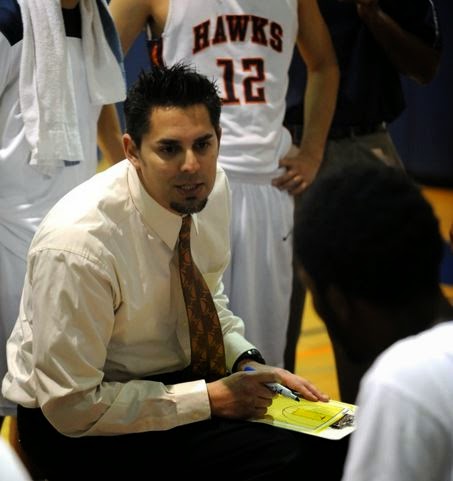
MR. 400 started at Consumes River before coming to Las Positas. His reputation is as a coach who cares about his players on and off the court. (Staff Photo)
To get there, he had to learn who he was. What values he wanted to hold as a coach. Early lessons tested and molded his perspective.
Back in 2005, Giacomazzi sought perfection. His intensity increased entering his second season as head coach of CRC, after missing the playoffs his first season. His standards needed raising.
One October practice, Scott fell short. He showed up late. Giacomazzi had been taught meticulousness was proof of commitment. Tardiness was an affront to such commitment. An illustration of Scott’s lack of passion. Something Giacomazzi couldn’t afford in his pending hunt for the postseason.
On top of that, Giacomazzi didn’t recruit Scott. He inherited the 6-foot-3 guard with the program he took over.
So when Giacomazzi noticed Scott walk across Clark Court at Cosumnes River, he was livid. With only a few weeks until their season debut, there was no room for such critical errors. As Scott pulled his coach aside, Giacomazzi was ready to unload.
But before starting his tirade, Giacomazzi saw something. Paint. On Scott’s pants. On his hands. His arms.
Giacomazzi asked about the paint first. Scott’s truth came to light. He worked as a painter to pay his rent. His Toyota Tercel only had two working gears, which relegated Scott to the backroads. His lateness wasn’t an absence of passion. He arrived to practice as early as he could manage. His circumstances prevented the holistic commitment Giacomazzi demanded.
The revelation blew Giacomazzi away. Scott was arguably more passionate, more committed, than any of his teammates because of what it took for him to get to practice. After their conversation, the coach finally saw the whole picture. Scott became a young man, not just a player. Giacomazzi became a leader, not just a coach.
The season became a success. CRC won 20 games, making the playoffs. They even beat the No. 15-seeded Foothill College on the road in the first round. And yet, the conversation with Scott is the memory that sticks in Giacomazzi’s mind.
“What I remember was, like ‘I don’t want to do this anymore,’” Giacomazzi said over a phone call, his voice carrying a reminiscing tone as he recounted the lesson the moment taught him.
“I don’t want to assume that everybody’s got it easy, that everybody’s got it made, that they can just show up whenever, and everything revolves around this. … I grew up that year (2005).”
Giacomazzi began to slow down from his “go, go, go” approach. He learned to enjoy the process. He understood that to truly make the impact he sought as a coach, his mindset had to expand past the clipboard and the hardwood. Connections took precedent.
The ethos of his modified approach was always there, present in his intangibles. Giacomazzi cared about his players. But, sometimes, it would get buried beneath the weight of expectations. The story of Scott ensured they remained the priority.
The foundation was laid during his time as a player at UC Riverside. Assistant coach Rusty Smith left a particular impression. He brought players into his home, providing food, comfort and vibes.
Even as a young head coach, where the pressure of success would cause Giacomazzi to not eat properly during seasons, he carried the example with him. He opened his home to his players, illustrating his true values before he even understood them well enough to explain.
“He was someone that I wanted to be around,” Dallas Jensen said. “Someone that I knew cared, someone that I could talk to, not just about basketball, but different things going on in life.”
Jensen was one of Giacomazzi’s first recruits, back when he was an assistant at San Jose City College in 1999. The pair have known each other for nearly three decades, with Giacomazzi helping Jensen transition into coaching. Jensen has been the head coach at the College of Sequoias since 2019.
Long-term connections became a product of Giacomazzi’s leadership. Whether for graduations, weddings, or helping in pursuits of career paths, Giacomazzi was present.
Even when one former player — 7-foot center Donald Mims, who joined CRC in 2013 and then followed Giacomazzi to the Nest in 2016 — was getting married in Canada during the season. Instead of showing up physically, Giacomazzi made time in his schedule to watch a Facebook live stream of the ceremony.
“He’s one of the only coaches that I still talk to to this day,” Spencer Wood said. Wood played for Giacomazzi in his first two seasons at LPC from 2015 to 2017, and then joined his staff as an assistant in 2018.
“He’s just someone that became a friend very quickly after I graduated. I always knew he was there for me after I transferred and anything I needed. … I think that’s one of his great traits — he makes you feel like family.”
Giacomazzi’s own family is the epicenter of his migration to the Nest.
While coaching at Cosumnes River, he lived in Elk Grove. His family and his wife Kristi Giacomazzi’s family lived in the Bay Area. The pair always sought a return, prompting a move to Livermore.
It forced Giacomazzi to commute 148 miles each day for seven years. When they began to build a family of their own, the drive led to moments missed.
A rare opportunity presented itself at Las Positas. A coaching job right in his backyard. But it wouldn’t come without sacrifice.
“Part of me making that decision,” Giacomazzi said, “which was a $20,000 pay cut, and I lost tenure, and I had to go through all those processes over again, was because of my family. … I’m a product of our college. I’m here in town, and my family can be a part of what I’m doing.”
From then on, building upon family ideals in his coaching became paramount. Not only did the Nest become his second home, but it also became a second family to his own. To his two daughters, Addison and Devyn.
“We wanted Las Positas and that basketball court to be like a second home to them, and it is,” Kristi Giacomazzi said. “We go support him at all the games.”
Fatherhood evolved Giacomazzi’s vision. His players were no longer just athletes — they were someone’s sons. Compassion replaced intensity.
He brought all of himself to work. He provided an example of what it meant to be a good dad. A good husband. A good man. Each roster saw all of who Giacomazzi is.
“What I realized is that you’ll actually maybe have more success, and just as much winning or more, with that,” Giacomazzi said. “Because they’re going to be willing to do anything and everything for you because they care about you so deeply, and that you have their best interest at heart, and that I want success for every single one of our players that come through our program. … I think our Las Positas students are getting a better version of Coach James.”
Looking back at his brash younger self, Giacomazzi recognizes the missed opportunities. He remembers the constant struggle, the pursuit of perfection.
“I felt like I was never happy that year,” Giacomazzi said. “Because it was like, as soon as we won — how do we win the next game? I j feel like I missed out on a lot of opportunities to dive into the people, who they were, and where they wanted to be and where they wanted to go.”
Now, the people are at the forefront. The moments and relationships fuel his winning legacy. His 71% win rate at LPC. Accolades such as being named Big 8 Conference Coach of the Year twice at CRC. NorCal Coach of the Year last season, on the team’s way to their second-ever Elite Eight run.
It’s what has powered him to the precipice of history. To the verge of 400 wins.
***
TOP PHOTO: James Giacomazzi leads the Hawks in the 19th annual Tony Costello Tip-Off Classic at The Nest. Entering the season, Giacomazzi was nine wins shy of 400. (Photo by Angelina An of The Express)
Jakob Arnarsson is an alum of The Express currently studying journalism at Arizona State University.