
Like most students, professor Mark Salinas commutes to LPC’s campus, where he teaches ethnic studies. Once those classes conclude, he commutes back to his hometown, Hayward, to instruct at Chabot College. His days don’t finish on a college campus — after Chabot, Salinas heads to City Hall.
Salinas knows Hayward inside and out. He grew up there in a working class family. He took a job at the local community college. And now, he’s on the city council acting as Hayward’s first Latino mayor.
Growing up in Hayward
As a child, Salinas never had Latino teachers. There was no available content related to his culture that caught his interest. His greatest disconnect, though, was his parents’ deliberate choice not to teach their children Spanish. Salinas was fluent only in English. It was through Chabot that he first truly connected with his Latino heritage.
Salinas’ first couple of months at Chabot were rough. He took a year off, but would eventually make his way back.
With his return came another discovery. Upon joining the Puente Project at Chabot, he began reading stories by Latino authors. Bringing home one of these books opened a conversation with his parents about their culture.
“I never had a Latino teacher,” Salinas said. “I never read a book by a Latino author, and nothing spoke to me. … It opened up a whole other sort of aspect of conversations in the house.”
Salinas’ parents told him of their experiences growing up Mexican in America. They were bullied for speaking Spanish when they were young, and didn’t want the same for their children. This was a revelation for Salinas — one in which he discovered the value of representation in education. It led to his pursuit of a career in ethnic studies and education.
Salinas’ new motivation sent him to San Francisco State University. He earned a bachelor’s degree in La Raza studies — now Chicanx or Latinx studies — in 1997.
Stepping in as professor at sister colleges LPC and Chabot
Growing up in a working-class family, Salinas believed work meant getting up early and performing hard labor. It wasn’t until he found Latino professors to look up to that he realized how much he wanted to be a professor, too. He could wear dress clothes to work. He could apply his mind, not his physical strength. He could be a role model for Latino students.
Salinas described the first Latino professor he encountered at SFSU, saying, “(the professor) was an academic and he always spoke well. He was Latino, and I had never seen that image before.” That professor, as well as Salinas’ experience in various college classes, made one thing clear: He wanted to be a professor.
Salinas continued his studies at SFSU until 1999, when he received his master’s degree in educational administration and public policy studies. He began working at Chabot in 2004, where he was one of three Latino faculty members. About a year later, he took more work at LPC to teach ethnic studies. He currently works at both schools.
Katie Ramos, a business major and one of Salinas’ students, can attest to the professor’s abilities. “I really like how, for like the whole class period, he just like speaks to you, not really just reading off the board” Ramos said. “He brings other people into the conversation. … He makes (class) more personable and more enjoyable, more interactive.”
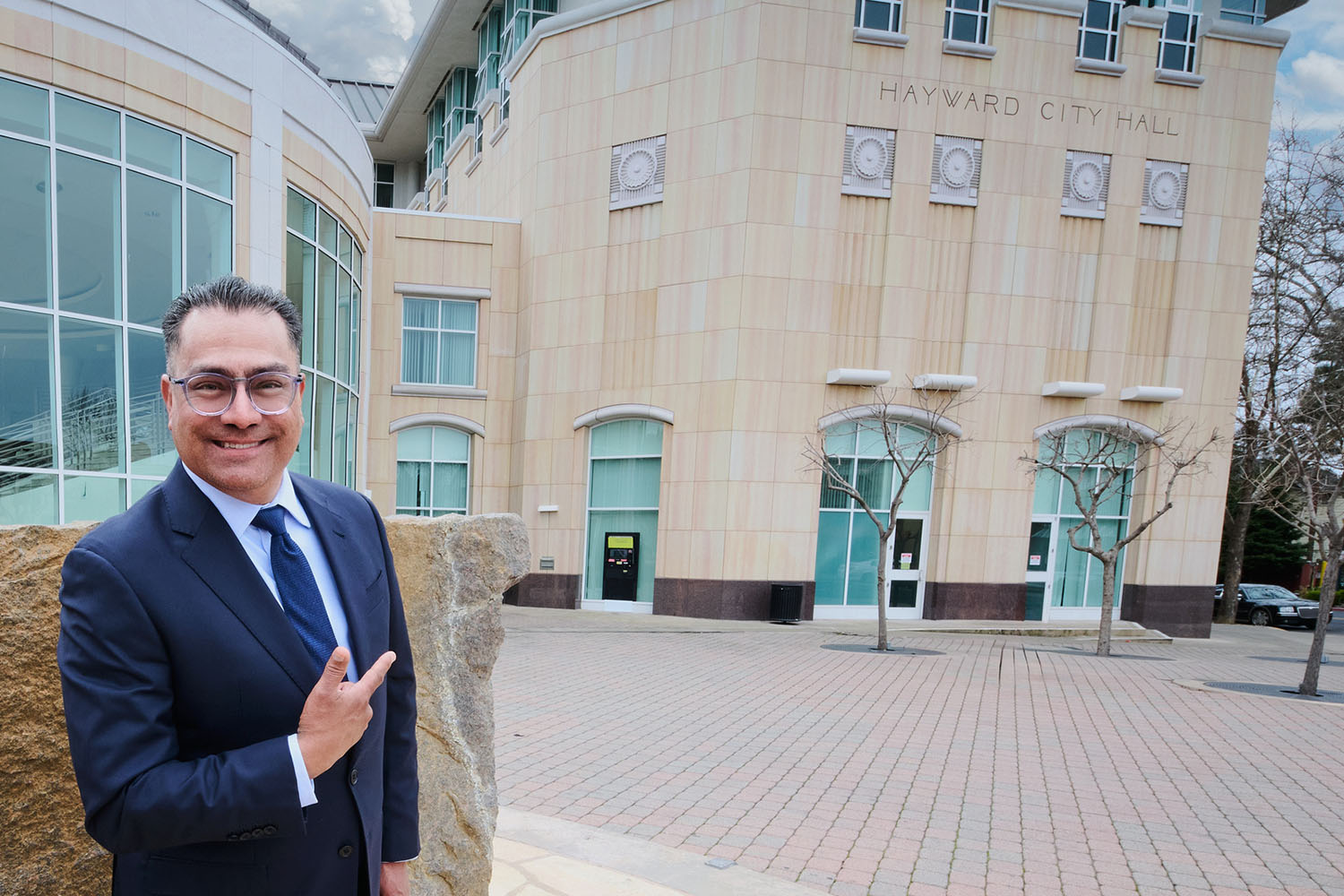
Assuming the role of mayor
With his career established, Salinas moved back to Hayward — where he noticed the city hadn’t developed alongsideother nearby cities. The cost of living was expensive, job opportunities were scarce and there was little community engagement from the city council.
Inspired, Salinas ran for the Hayward City Council and was elected into office in 2010. He ran for mayor in 2012, but did not succeed in election. Because he could only run for one office at a time, he was removed from the city council from 2012 to 2016. This was a repeat occurrence: Salinas was elected for the city council for the 2016-18 term, but was out for the 2018-20 term. In 2020, he was re-elected to the city council for his third term.
In 2022, Salinas finally succeeded in his race to become Hayward’s mayor. He ran unopposed, endorsed by the previous mayor, Barbara Halliday. This made him the first non-white and Latino mayor of Hayward. Salinas ran on a message of supporting young families: ensuring children have a safe future in the city and turning Hayward into a hub for education.
Hector Garcia, trustee for Las Positas and Chabot, believed that Salinas has always considered and even met the needs of Hayward residents. “He actually walks the (walk) of engaging with (the) community — that both look like him and don’t look like him — recognizing that there are unique circumstances, needs, skills (and) gifts that each of those communities bring to Hayward.”
Salinas is faced with unique double standards, which come with his status as a Latino mayor. He is expected to attend events and be seen by his community on a greater level. It has the potential to be stressful — yet it has allowed him to be more engaging than his predecessors. He uses his experiences to approach problems through equity and historical contexts.
“It’s an extraordinary honor and it’s an extraordinary privilege to be the mayor,” Salinas said. “I’m very aware that when people look at me, and when people watch me do my job, they’re not only looking at me, but they’re also looking at a Latino. It’s an honor, it’s a responsibility. And it’s a responsibility that I take seriously, not lightly.”
Maximilien Kiyoi is a staff writer for The Express.