

Luke Caba Guerrero Lam took a seat in Dylan McBride’s class, Musical Theater Workshop. It was fall 2023, and Caba Guerrero Lam had just transferred from Castro Valley High School. He found himself surrounded by the kind of talent he could only hope to have within. People who could belt, dance and command the room were what he was up against.
New class. New environment. New people. New worry.
“I remember feeling like I didn’t belong,” he said, “because I didn’t size up to the same levels of talent.”
Like many imposter syndrome sufferers, Caba Guerrero Lam experiences an overwhelming amount of pressure from wanting to be better. But, more importantly, Caba believed he should already be better.
He said it came in waves. Some days were good. He felt proud. Other days, he didn’t feel like enough.
Many students believe their success is undeserved. They convince themselves that something they have earned — receiving academic awards, completing a degree or becoming a captain on their school’s sports team — was more a product of sheer luck.
You may know the feeling. Always doubting if you belong. Attributing your success to a circumstantial fluke. Worried that, at any moment, you will be discovered as actually unworthy.
What most call “imposter syndrome” was first coined “impostor phenomenon” in 1978 by two American psychologists who found the central defining feature of the impostor phenomenon is the cognitive belief that other people overestimate their competence.
The main cause of imposter syndrome is unclear. What triggers this phenomenon in one’s life is as varied as the situations, ranging from typical fear of failure to deep-rooted psychological patterns from childhood.
There is no “cure” for imposter syndrome. Not in the traditional sense. It can become manageable with time (and maybe a prescription). But no doctor actually diagnoses anyone with imposter syndrome.
In medical expertise, it does not actually exist. It’s just a catchy name for psychological conditions already recognized, such as anxiety.
Yet, according to a 2019 study by Brigham Young University, imposter syndrome is real among college students. Estimates declare about 20% of college students suffer from this syndrome — that’s just those who admit it — and it is almost always unrelated to their actual performance.
With the parade of “perfect lives” on social media in 2025, students tie themselves to comparison. The increased susceptibility of college students demands that they find ways to fight against their conditioning for low self-esteem. Developing resilience now could prevent imposter syndrome or, for the 20%, overcome it when it inevitably arrives.
“The world,” said Bini Sebastian, a senior staff psychologist at the UC Berkeley in Student Mental Health, “already makes it hard for anyone to feel good enough, you know? There are so many exclusive spaces here and, so, most of us are kind of conditioned and fed to believe that we need to look a certain way, be somebody, in order to feel good enough. So the system that we live in already does not cater towards someone feeling satisfied with themselves.”
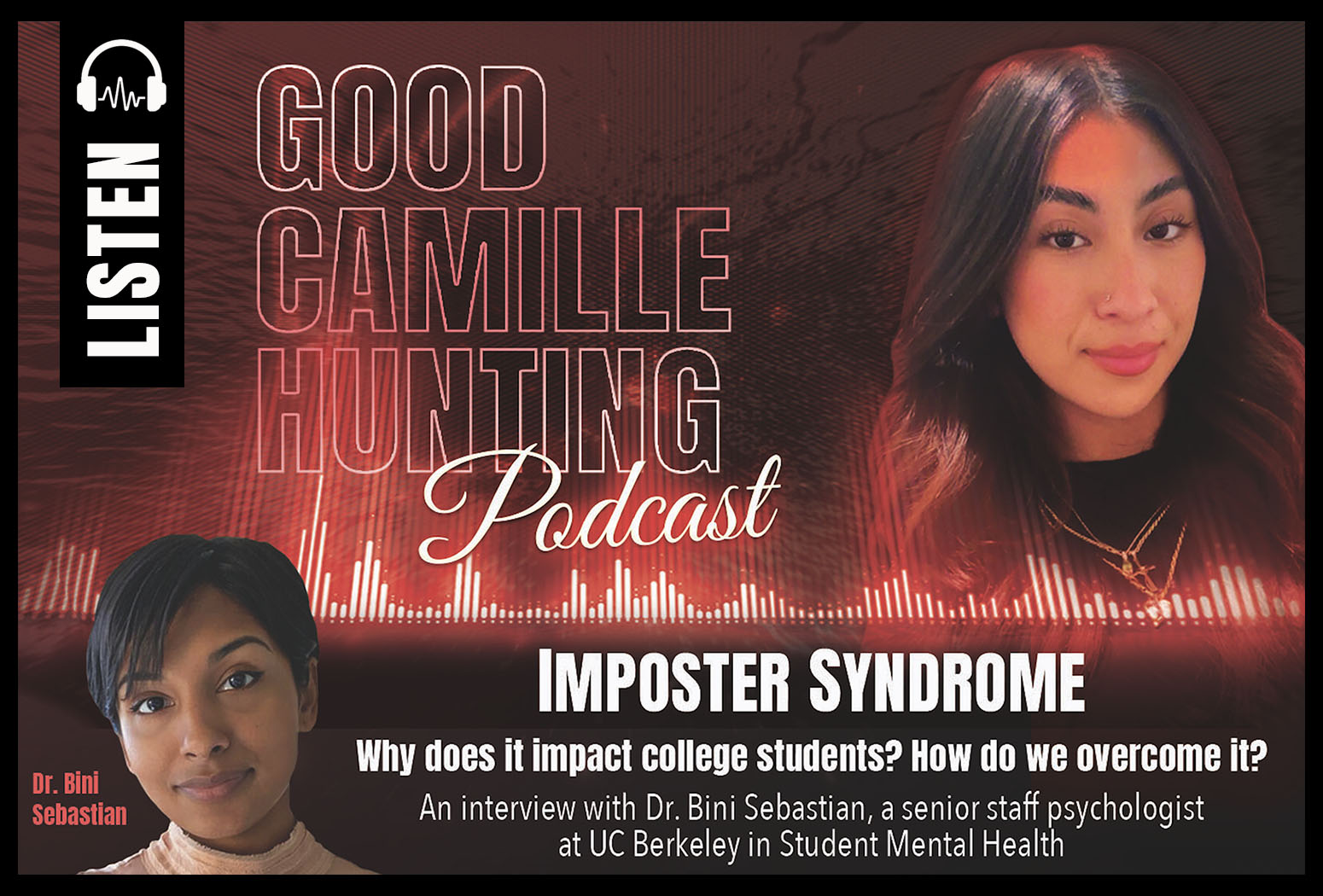
The experience of imposter syndrome
Professionals say this is a common and predictable syndrome for college-age students.
“It is so common,” Sebastian said, “If I were to gather 30 students and ask them who experiences some form of imposter syndrome, I’m going to guess, if not all 30, 29 students will raise their hand.”
College students are easy targets for imposter syndrome. The new landscape of social media has completely shifted their expectations — of themselves, of their path forward, of how their lives should look at this point.
The expectations that come with not only upholding grades but also finding a profitable career make for an incredibly high-stress existence.
Some people don’t know they have imposter syndrome because they are unaware of its definition. In a modern society filled with constant comparison, it might even feel too normal to seem like a condition.
But the syndrome can be crippling and incredibly lonely. To work so hard to earn a position, to reach a level, or achieve a goal, only for it not to feel right upon arrival. The feeling of being fraudulent, unqualified and unworthy robs the joy of the accomplishment.
Everyone else appears worthy, perfect even. Sufferers of imposter syndrome, who know all of their own flaws, find it difficult to match up when they compare themselves to the highlights they see of their peers. The accomplishments and experiences of others seem much more valid. Students who question whether they truly deserve their success tend to dismiss the results of hard work as luck.
“I constantly wonder if I’m faking it,” sophomore Las Positas student Gabrielle Drewes said. “Even if I know it’s in my head or I’m doing my best, the thought of, ‘Have I put enough effort forward to be here?’ still exists.”
Perhaps the worst part for someone with imposter syndrome is the constant fear of not being able to hide it well enough. Sufferers can feel in constant danger of being discovered as an imposter, one who doesn’t belong.
It leads to overwork and over-functioning, which increases the stress and likelihood of burnout. The hard work that goes into proving one’s excellence does not last for a person battling imposter syndrome. Typically, there is a shift when they see others thriving much faster or with more ease than when they experienced it for themselves.
“Something that comes immediately to mind is high school,” LPC freshman Dylan Ting said. “My accomplishments there were great but when I came here, the environment was different and I found myself wondering if my skills actually exist.”
Imposter syndrome presents itself in several ways. One way is perfectionism, according to Vanessa Van Edwards, best-selling author of Captivate: The Science of Succeeding with People, Cues: Master the Secret Language of Charismatic Communication, and viral TEDx London speaker, who wrote about imposter syndrome for Science of People. This is the desire and need to be the best. For some, being the best is the only thing that will pacify the doubt. These self-imposed standards can produce unrealistic or unattainable goals.
The simple act of setting expectations can create a snowball effect.
Perfectionism can lead to another layer of imposter syndrome, what Edwards called “super heroism” — which also relates to the idea of needing to be the best. This above-and-beyond mentality provokes validating results and feedback as a way of addressing the unworthiness.
The fear-of-failure stage usually hits when confronted with achievement-based goals. Individuals may experience anxiety and fear of being humiliated or ashamed if they fail at the task.
The pressure to uphold a standard is what creates chaos in a mind suffering from imposter syndrome. The constant worrying, the what-ifs, the false-alarm moments when they think they’ve been discovered as a fraud. These psychological burdens harm one’s mental health.
Eventually, it can lead to disregard of one’s intelligence, the diminishing of one’s experiences and credentials, and rejection of even the most obvious evidence of one’s capabilities. Sufferers might even pass up opportunities and not take full advantage of their talents because they are convinced failure is inevitable.
“Excessive self-criticism is another symptom,” Sebastian said. “The discrepancy between how I view and evaluate myself versus the external feedback and criticism is night and day.”
This typically causes the most pressure. Imposter syndrome is, essentially, an internalized disbelief that one isn’t worthy of success. The irony comes in that success doesn’t necessarily prove the fraudulent feeling as wrong. Instead it makes it even worse. The doubt then shifts to the seemingly impossible task of doing it again. Success only makes upholding the standard of one’s success that much more daunting.
“You shouldn’t have to be confused,” Ting said, “about who you are when great things are happening to you.”
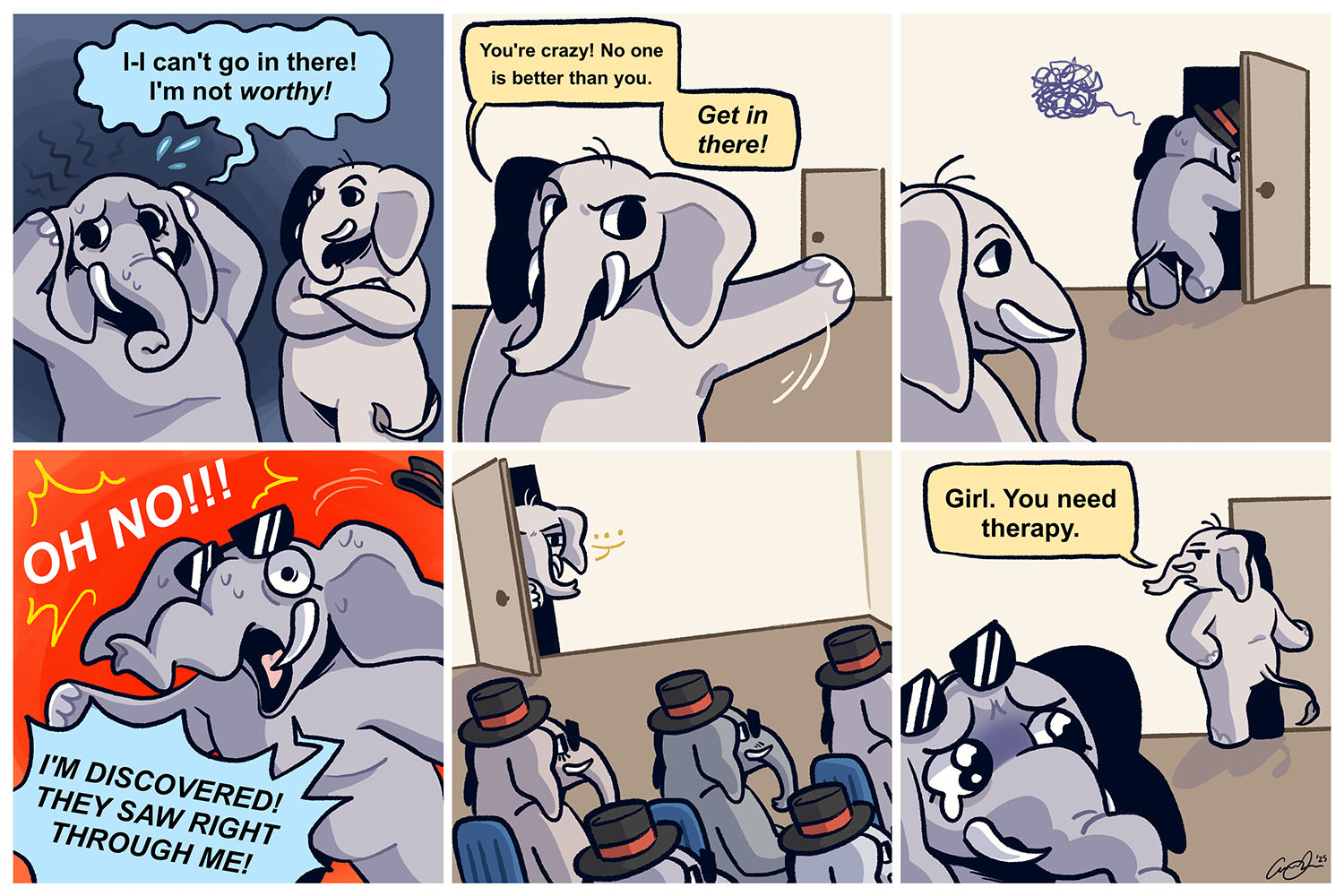
(Cartoon by Aaliyah Gholamipour / Special to The Express)
The causes of imposter syndrome
Many things are responsible for this mental rut. The reason for that is, technically, imposter syndrome is not actually a diagnosis. It’s a socially created title to explain a common feeling.
“A lot of us don’t learn how to deal with our emotions in school,” Sebastian said. “And most of us think that we all experience three different emotions: happy, sad and mad. Now, on top of that, based on identities that could normalize other emotions.”
The origins of imposter syndrome date back nearly 50 years to American psychologists Pauline Clance and Suzanne Imes. To get to the bottom of the trend of women who felt fraudulent in their careers, they wrote the paper “The Imposter Phenomenon In High Achieving Women.”
Clance and Imes spoke to over 150 capable career-driven women, and each response solidified the idea that women believed the success they’d attained was attributable to sheer luck or mistake.
“Women that experience the imposter phenomenon maintain a strong belief that they are not intelligent,” the report declared. “In fact, they are convinced they have fooled anyone who thinks otherwise.”
But when searching deeper into the women’s childhood, they discovered two types of upbringing created the same imposter result. In one group of women, they found families designated which sibling was the more intelligent and accomplished early on.
The comparison to her other sibling haunts her, even if she has outstanding grades and other achievements. The woman’s continuous drive to obtain validation can create impostor syndrome.
She thinks her family may be correct, secretly doubts her intellect, and begins to wonder if she has gained her high marks through sensitivity to teachers ‘ expectations, social skills, and feminine charms, the paper stated.
In the other group, the women had a family that believed they were superior in every way. Always encouraged, the woman was pushed to believe she could accomplish anything she wanted in life.
Yet the opposite effect crept in. She begins to wonder if any of her talents are real. The praise feels unearned because it always comes, no matter what. Thus, the same syndrome originates.
Because she is so indiscriminately praised for everything, she begins to distrust her parents’ perceptions of her. Moreover, she begins to doubt herself. She jumps to the conclusion that she must be dumb. She is not a genius; therefore, she must be an intellectual impostor.
But the syndrome, which most experts believe originated with Clance and Imes’ research, is no longer a women’s issue. Today, it impacts men and people from oppressed demographics.
“Did you receive messages from your family members, peers, or teachers, from your society that you needed to be something other than who you are in order to meet a certain criteria or standard?” Sebastian said. “Those are often the roots of it and it’s a thinking pattern really. You might have experiences that confirm this idea that you are not good enough.”

The treatment of imposter syndrome
The first step in addressing the syndrome is acknowledging it is a subjective line of thinking. Sufferers live in their own realm of failure, never leaving because they never acknowledge being stuck there. As a result, they are always governed by objective reality.
“Usually when I feel the syndrome,” Dylan Ting said, “I have to get out of my head. When you feel something negative, it’s so easy to spiral. Getting out of your own space, whether that be a walk or talking to someone you know, really helps.”
Arizona State’s Graduate College developed best practices for developing resilience to imposter syndrome. It cited information gathered from the American Psychological Association and a 2018 article in Time Magazine on dealing with imposter syndrome.
The first of the six practices: talking about it. Creating a support group of peers and mentors keeps differing perspectives close.
The second practice: recognize your expertise. Mentor others. Tutor. Provide valuable insight to others. The experience reminds one of how much they do know.
The third practice: acknowledging strengths. The hyper-focus on failures and perceived weaknesses creates an echo chamber. Even creating a list of strengths helps stop spirals of negativity.
Sebastian created a folder that she keeps on her desktop. It features a document where she lists out the praises she has received. The compliments serve as a reminder of another perspective when she’s lost in her imposter syndrome.
“So it’s not just me talking to myself,” she said. “But, no, Bini, you are worthy. You are doing great. Seeing someone give me that feedback is an ongoing process.”
The fourth practice: do ‘well enough.’ Perfectionism is a common trait among imposter syndrome sufferers. When perfection seems impossible, the best option is often to do nothing. Doing something and acknowledging the work put in is a counter to the paralysis of perfectionism.
The fifth practice: practice mindfulness. Taking time to meditate daily without judgment builds the discipline required for overcoming.
The sixth practice: change internal narrative. The negative voice inside is loud in sufferers of imposter syndrome. Taking a deep breath, focusing, and reframing the internal narrative can slow or stop the snowballing negative self-talk.
It turned out pretty simple when Caba Guerrero Lam changed his internal narrative. He sat in his musical theater class feeling every ounce of his imposter syndrome. Overwhelmed by the talent around him, he doubted if he should be in the class. In the Actor’s Conservatory. At the school.
As the class progressed, Caba was struck by a simple truth. He didn’t need to match the greatness around him. It wasn’t his time to do so yet.
He was there to learn. To get better at the craft. He was worthy of learning. So even if he didn’t match up talent-wise with the rest of the class, he was supposed to be in the room where people learned to use their talents. He was in the right place.
And not an imposter at all.
***
TOP PHOTO: What began as a phenomenon nearly 50 years ago, explaining the feelings of women in the workforce, has become a common trait among college students. (Photo Illustration by Ian Kapsalis/ The Express)
Camille Leduc is the Editor-in-Chief of The Express. Follow her on X, formerly Twitter, @CLeduc7603.